Youth label system
At Climbing Network, we work with a Label System for climbing with minors. This system was developed by Climbing Network in 2016 and has been revised three times since then. This takes into account developments in climbing, feedback from the trainers/instructors and the risks in climbing. On this page, we explain the purpose and operation of the label system. Do you have any questions about the label system after this or how this system affects what your child is allowed to do during climbing training? Don't hesitate to ask them to your child's youth coach or one of your child's other supervisors!
Introduction
At Climbing Network, we work with a Label System for climbing with minors. This system was developed by Climbing Network in 2016 and has been revised three times since then. This takes into account developments in climbing, feedback from the trainers/instructors and the risks in climbing. On this page, we explain the purpose and operation of the label system. Do you have any questions about the label system after this or how this system affects what your child is allowed to do during climbing training? Don't hesitate to ask them to your child's youth coach or one of your child's other supervisors!
The system is based on the SVK's guideline for climbing with minors and includes a division into age groups. The CN Label System works with the division into youth categories as used in Dutch and international climbing (NKBV and IFSC). As a result, in certain cases, the CN Label System differs from the ages specified in the general SVK guideline for climbing with minors.
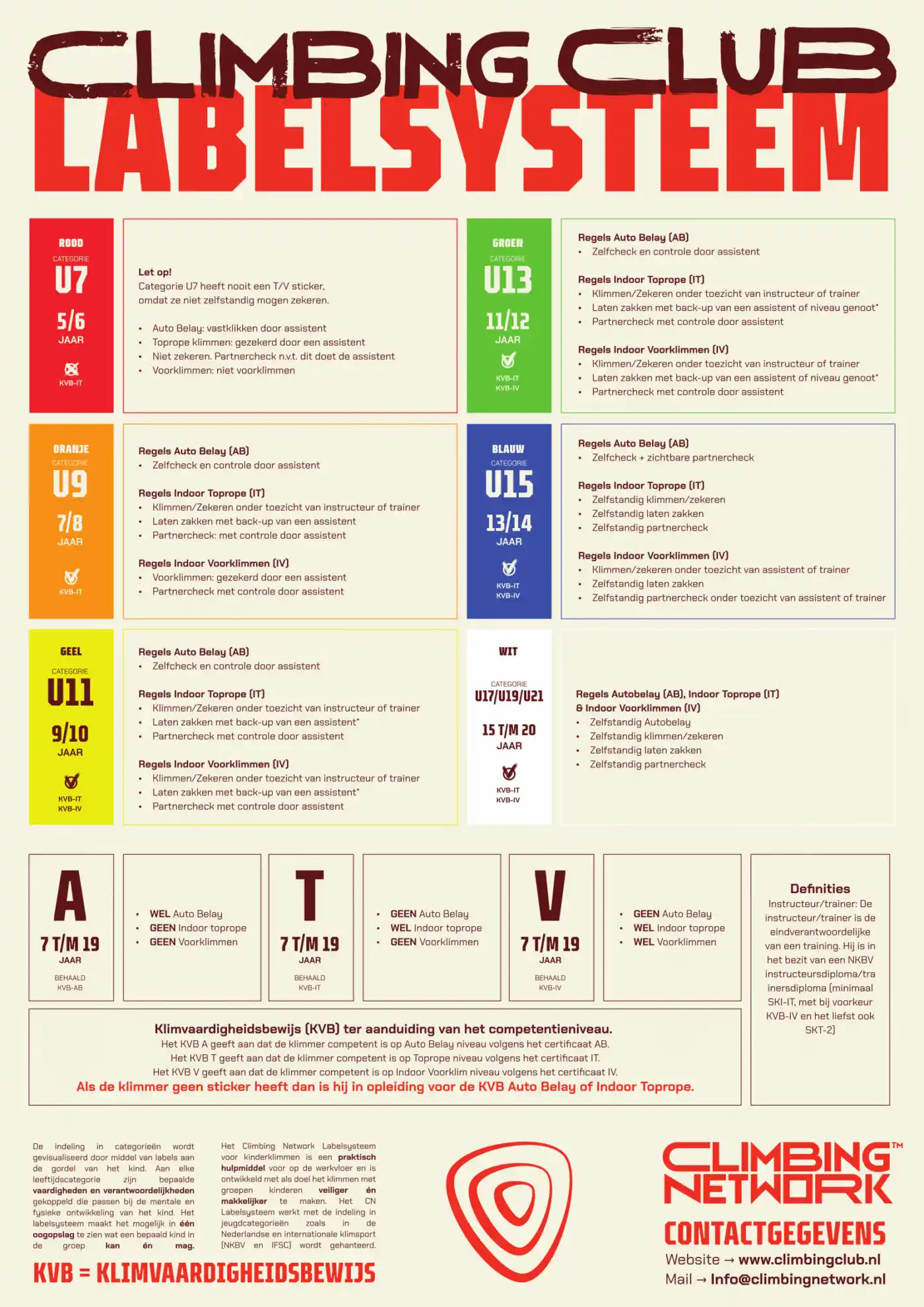
The division into categories in the CN Label System is visualized by means of colored labels on the child's belt. Each age group has certain skills and responsibilities associated with the child's mental and physical development. The label system makes it possible to see at a glance what a particular child in the group can and is allowed to do.
Watch here is the poster of all labels and categories. At first, it seems like a complex system, but in practice it is not. Kids and trainers at the Climbing Club are used to working with the label system. Below, we explain how the label system works.
Acts
Certain climbing activities are potentially risky and are even more so for children than for adults. After all, young children cannot oversee their own actions and their consequences in the way adults can. Children's attention spans are also less than that of adults. The SVK Label System therefore assigns children certain skills based on their age. This involves the most risky actions when climbing. These are tightening the belt, tying in, the SVK Partner Check, securing and lowering. The Label System also distinguishes between Toprope climbing, Auto Belay climbing and Pre-climbing.
The youngest categories of children we deal with in the climbing gym will have to have the critical actions carried out under the direct supervision of an instructor/trainer or assistant. As the child grows up, the skills that the child is allowed to perform independently are expanded.
Using the System
The label system has eight categories and six label colors. Each category has a label with a specific color, with the U21, U19 & U17 youth having the same label color. The system is primarily based on age groups as we know them from other sports; the U7, U9, U11, U13, U15, U17, U19 and U21. The label is attached to a belt material loop. In this way, it is clear to guidance, the children and the parents what the specific child's powers are.
Lower limits, deviations and exceptions
The age limits set out in the CN Label System are lower limits, which means that it is the minimum age for which certain rules apply. For each company or organization, you can choose to only assign skills at a later time. In certain exceptional cases, the instructor may deviate from the age limit downward. Deviations from the SVK climbing directive for minors:
• Children aged 12 and 13 who are classified in category U15 may climb and secure Toprope independently within the training, but not outside the training. Outside the training, you are allowed
that from the age of 14, provided that you have a KVB-IT.
• Children aged 14 and 15 who are classified in category U17 may climb and secure independently within the training, but not (yet) outside the training. Outside the training
this is allowed from the age of 16, provided that you have a KVB-IV.
Label system validity
The Climbing Network Label System is a system that has been used locally since 2016 and only applies to guided activities. The label system cannot be used in climbing halls where the label system is not used. The label system is also not transferable between climbing halls. The conditions, (house) rules and safety guidelines of the climbing hall where you are going to climb are leading.
LABELS/AGE RANGES
When dividing into categories, it is not the age at a specific date, but the year in which the child reaches the age that is decisive. In other words, the classification is by year of birth. See table below;
STICKERS DENOTING THE CLIMBING SKILL CERTIFICATE
The KVB A states that the climber is competent at Auto Belay level, according to the AB certificate.
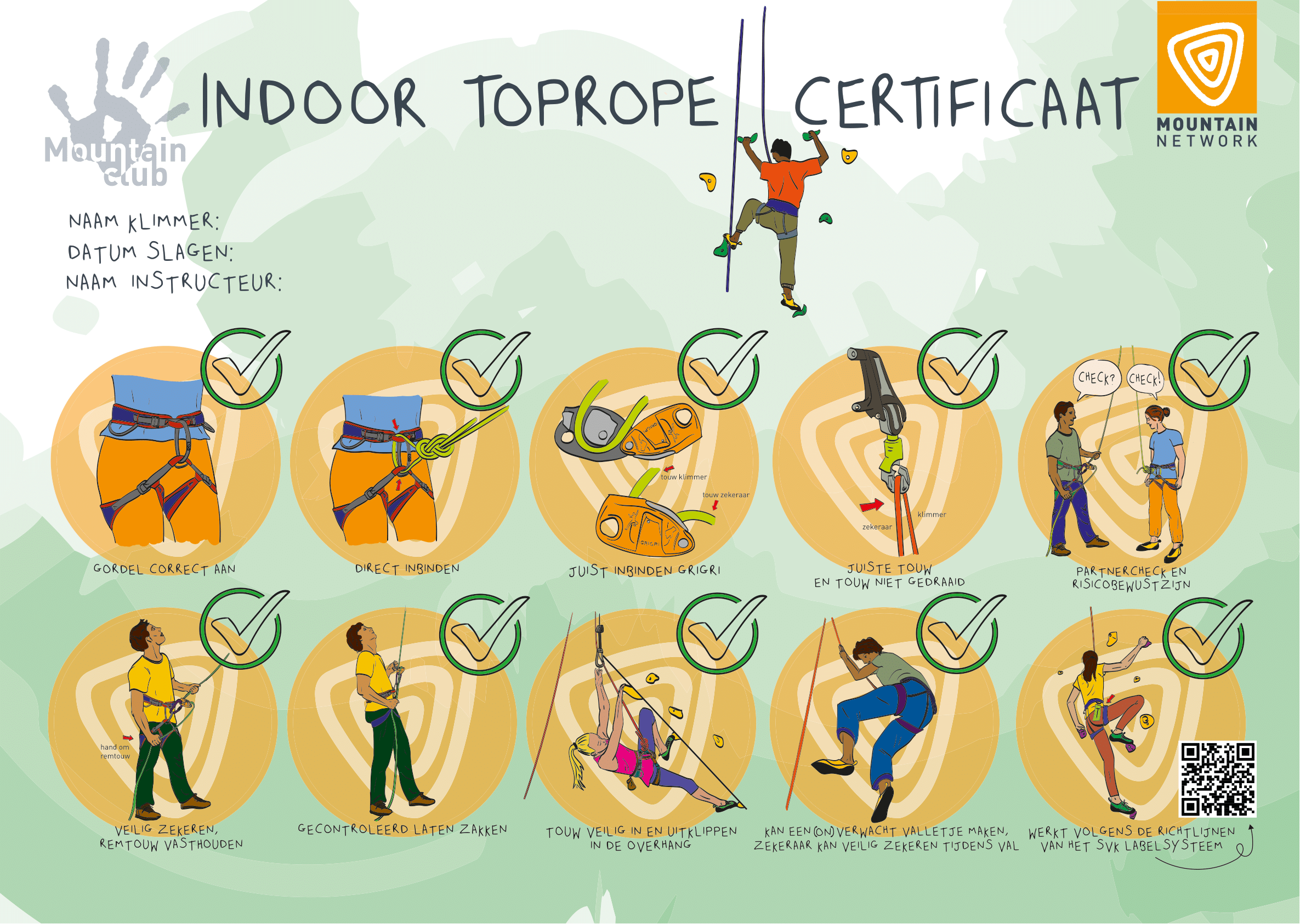
The KVB T indicates that the climber is competent at Toprope level, according to the IT certificate.
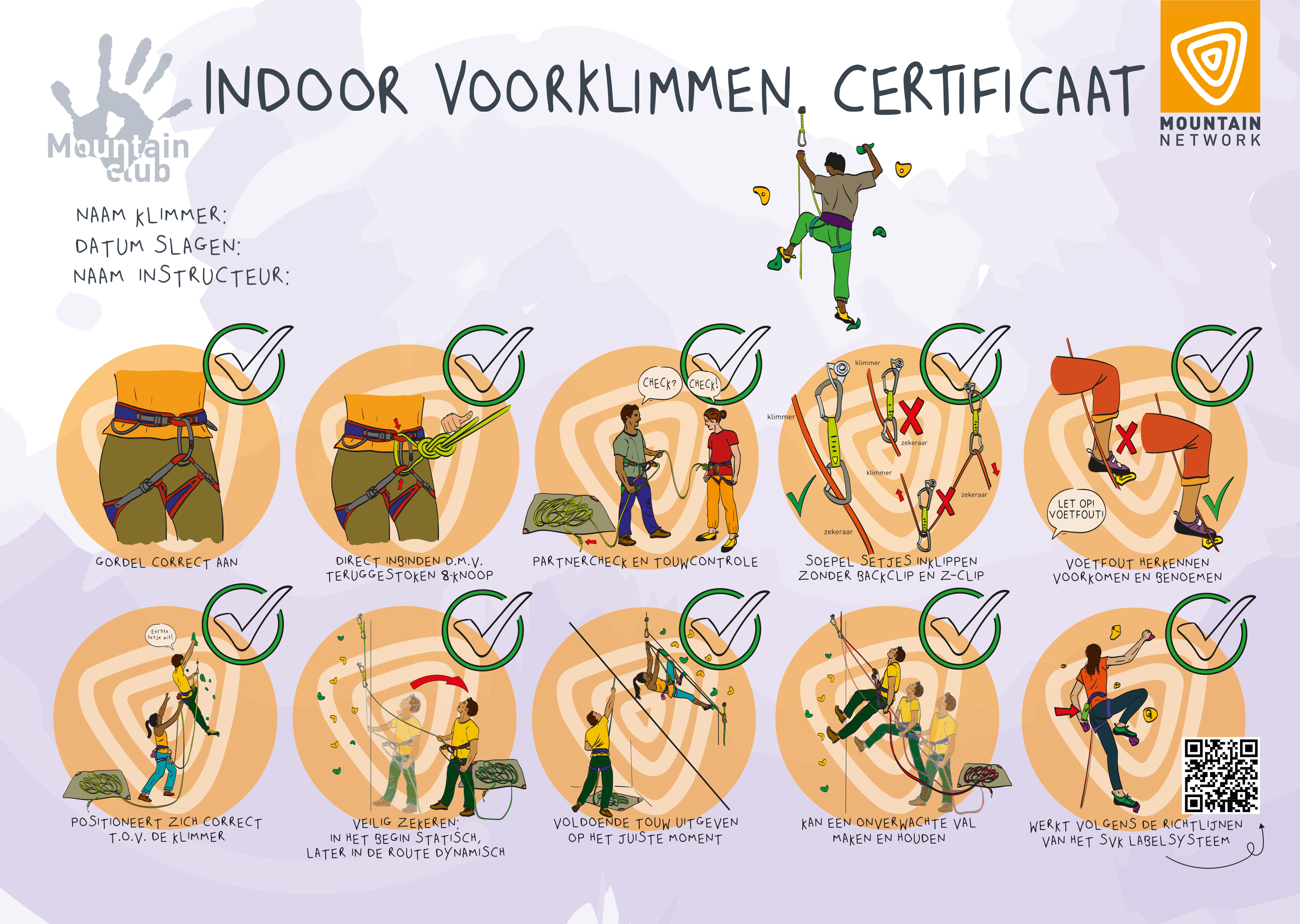
The KVB V states that the climber is competent at Indoor Pre-Climb level according to the certificate IV
If the climber does not have a sticker, he is training for the KVB Auto Belay or Indoor Toprope.
A7 to 19 years old, KVB-AB achieved
- WELL Belay Car
- NONE Indoor toprope
- NONE For climbing
T7 to 19 years old, achieved KVB-IT
- NONE Belay Car
- WELL Indoor Toprope
- NONE For climbing
V7 to 19 years old, achieved KVB-IV
- NONE Belay Car
- WELL Indoor toprope
- WELL For climbing
OVERVIEW OF (UN) PRIVILEGES PER LABEL
CAT U7 (RED): 5/6/7 WITHOUT KVB
Attention! Category U7 never has a T/V sticker, because they are not allowed to secure independently
- Auto Belay: click on by assistant
- Toprope climbing: secured by an assistant
- Not sure. Partnercheck n.v.t. this is what the assistant does
- Pre-climb: do not pre-climb
CAT U9 (ORANGE): 7/8/9 YEARS OLD AND OWNED BY KVB-IT
Auto Belay (AB) Rules
- Self-check and control by assistant
Indoor Toprope (IT) Rules
- Climbing/securing under the supervision of an instructor or trainer
- Lose down with assistant backup
- Partner check: with assistant control
Indoor Pre-Climbing Rules (IV)
- Pre-climb: secured by an assistant
- Partner check with assistant control
CAT U11 (YELLOW): 9/10/11 YEARS OLD AND OWNED BY KVB-IT/KVB-IV
Auto Belay (AB) Rules
- Self-check and control by assistant
Indoor Toprope (IT) Rules
- Climbing/securing under the supervision of an instructor or trainer
- Lower with assistant backup*
- Partner check with control by assistants
Indoor Pre-Climbing Rules (IV)
- Climbing/securing under the supervision of an instructor or trainer
- Lower with assistant backup*
- Partner check with assistant control
CAT U13 (GREEN): 11/12/13 YEARS OLD AND OWNED BY KVB-IT/KVB-IV
Auto Belay (AB) Rules
- Self-check and control by assistant
Indoor Toprope (IT) Rules
- Climbing/securing under the supervision of an instructor or trainer
- Drop with backup from an assistant or level mate*
- Partner check with assistant control
Indoor Pre-Climbing Rules (IV)
- Climbing/securing under the supervision of an instructor or trainer
- Drop with backup from an assistant or level mate*
- Partner check with assistant control
CAT U15 (BLUE): 13/14/15 YEARS OLD AND OWNED BY KVB-IT/KVB-IV
Auto Belay (AB) Rules
- Self-check + visible partner check
Indoor Toprope (IT) Rules
- Independent climbing/securing
- Lower independently
- Independent partner check
Indoor Pre-Climbing Rules (IV)
- Climbing/securing under the supervision of an assistant or trainer
- Lower independently
- Independent partner check under the supervision of an assistant or trainer
CAT U17 (WHITE): 15/16/17 YEARS OLD AND OWNED BY KVB-IT/KVB-IV
Indoor Toprope (IT)/Indoor Pre-Climbing (IV)
- Self-employed Auto Belay
- Independent climbing/securing
- Lower independently
- Independent partner check
CAT U21/U19 (WHITE): 17/18/19 YEARS OLD AND OWNED BY KVB-IT/KVB-IV
Indoor Toprope (IT)/Indoor Pre-Climbing (IV) Rules
- Self-employed Auto Belay
- Independent climbing/securing
- Lower independently
- Independent partner check
STARTERS (U7 TO U21) IN TRAINING FOR KVB-IT/KVB-IV
- Secure with level-mate backup, supervised by an assistant
- Lose down with assistant backup
- Partner check with assistant control
- In training for KVB-IT: don't climb ahead
* A climbing gym can make an exception for specific children on the recommendation of the trainer/instructor. In that case, that child can lower another child under the supervision of the trainer/instructor.
Definitions
Instructor/trainer definition: The instructor/trainer is ultimately responsible for a training. He has an NKBV instructor diploma/trainer diploma (at least SKI-IT, preferably KVB-IV and preferably SKT-2) or demonstrably equivalent status or experience (at BKS or in-house).
Assistant trainer definition: The assistant trainer is at least 16 years old and is responsible for a number of rope groups within the training. He has an NKBV supervisor diploma (SKB2-IT, preferably KVB-IV and preferably SKT-2) or demonstrable equivalent status or experience (at BKS or in-house).
Assistant definition: the assistant is at least 14 years old, has a KVB-IT or KVB-IV (at least 16 years) or demonstrably equivalent status/experience and, at the level of KVB achieved, can be responsible for safety within one rope group. The assistant is always managed by an assistant trainer or an instructor/trainer.
Fuse devices
The use of a semi-automatic machine (“brake hand-independent” semi-machines and autotubers) is in most cases recommended when securing for children. See the 'Recommendation for safe securing when sport climbing'by the NKBV. Within the Climbing Club, people up to the age of 16 always use a Grigri. The Grigri is a semi-automatic and will block if someone unexpectedly falls out of a route.