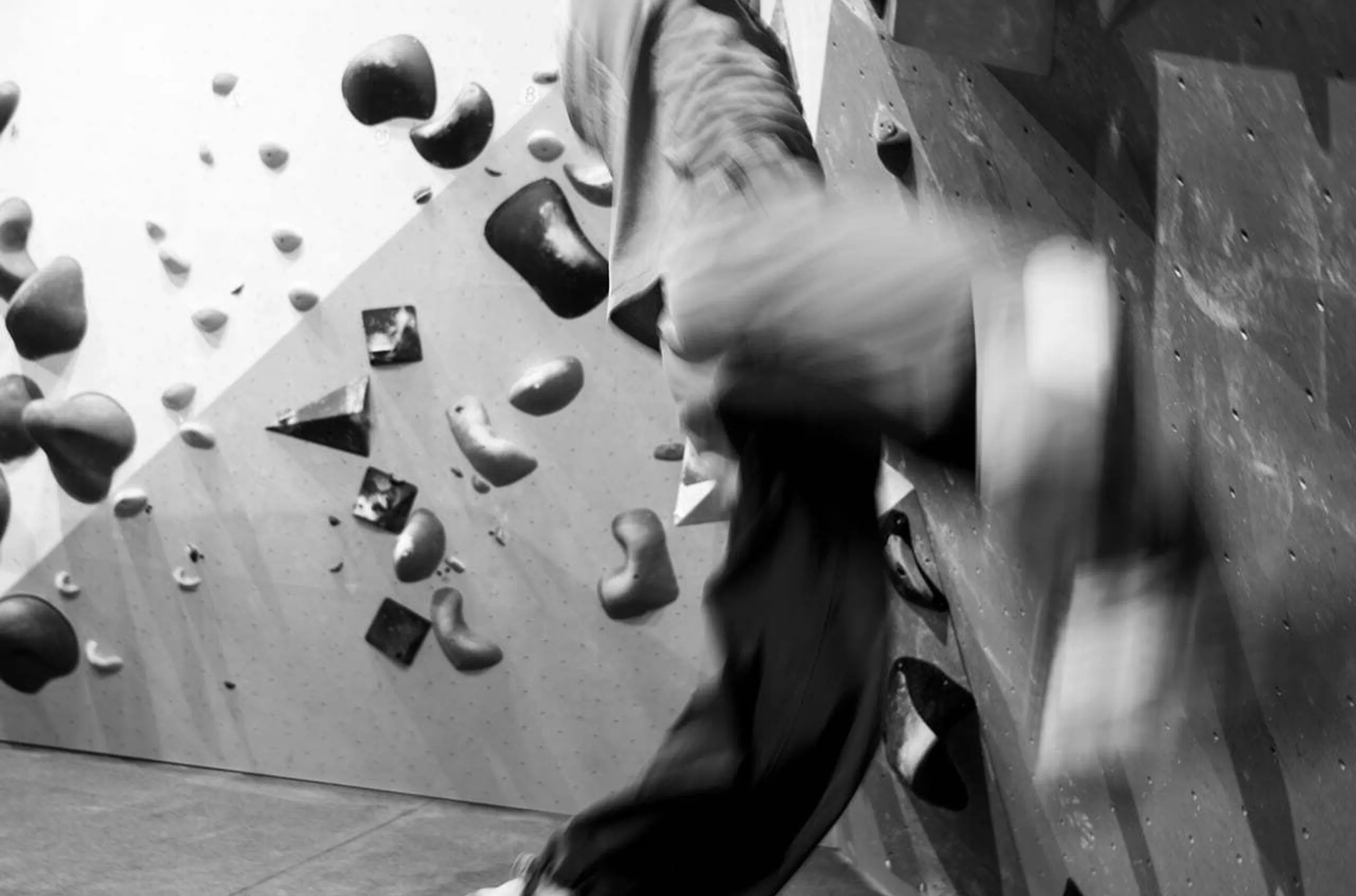
Recovering without letting go of the wall: keep climbing responsibly

By Anne Harm Nauta, sports physiotherapist at TopFysio Leeuwarden and physiotherapist at the injury clinic at Climbing Center Leeuwarden.
How to make targeted adjustments to your training load when climbing causes pain, stay active, and prevent a minor injury from keeping you off the wall for a long time.
As a beginner climber, you don't need to stop for every little ache. That said, carrying on as if nothing is wrong isn't wise either. By taking a close look at the injury, as well as at the way you climb and train, you can often adjust your load so that you stay active during your recovery.
Why injuries can develop, especially in your first year of climbing
When you start climbing, you often notice that your level rises quickly. Your movements become more efficient, you place your feet better, and routes that first seemed impossible are suddenly within reach. The strength in your arms and back can also increase significantly in a short time.
However, the load capacity of your fingers, tendons and shoulders doesn't always develop at the same pace. As a result, you may already be able to handle harder routes technically and in terms of fitness, while certain tissues are not yet used to the higher pulling forces, small holds and repeated attempts. This has little to do with a lack of ability. It is a logical consequence of rapid progress in a sport with a very specific type of load.
The risk therefore lies not only in how often you climb. Intensity can also increase sharply without you noticing. An extra evening of bouldering, trying the same crux more often or holding on to more small edges can be more demanding than a longer session on large holds and relaxed routes. Your climbing time may have barely changed, but the load on a finger, elbow or shoulder has.
Advice from other climbers is valuable, but not always enough
A lot of knowledge is shared in a climbing gym. Experienced climbers give tips on technique, warming up, rest, taping and choice of holds. That practical experience is valuable and often helps new climbers to train smarter.
The difficulty is that two injuries that feel the same do not always have the same cause. Pain in a finger, for example, can come from a pulley, tendon, joint or muscle. Shoulder pain can be related to muscle fatigue, limited movement control, a sudden increase in training load or a specific movement on the wall.
As a result, a tip that works well for one climber may make little difference for another, or may even keep irritating the injury. ‘Avoid crimping for a while’ sounds logical for finger pain, but it doesn't tell you which holds and forces you can still handle. ‘Strengthen your shoulders’ can be useful, but only if it is clear which function is falling short and how heavy that training can be at that point.
Continuing to climb is not the same as climbing through pain
For many injuries, stopping completely is not automatically the best solution. After all, climbing is not one fixed type of load. A calm, technical route on large holds asks something different of your body than repeatedly projecting at your maximum level.
Continuing to climb in a modified way means consciously choosing what you will and won't do for the time being. With a sensitive finger, this may mean avoiding small edges, hard crimps, pockets or dynamic catches. You can then choose larger holds, less steep routes and controlled movements. With shoulder injuries, it may be necessary to temporarily limit deep lock-offs, long sideways moves, gastons or unexpected dynamic movements.
The number of attempts also matters. Trying one difficult move ten times in a row is different from climbing several routes where the load is spread out. Sometimes, therefore, the best adjustment is not a lower grade, but fewer attempts on the same move, more recovery between routes or a shorter session.
How your body reacts after climbing gives you important information. If the pain stays stable, your technique doesn't change because of the pain, and the reaction later that day or the next morning is limited, then modified climbing is often possible. If the pain increases with every attempt, you lose strength or you start compensating more and more, the load is probably still too high.
Recovery takes more than just rest
Rest can temporarily calm an irritated structure, but it doesn't prepare your body for a return to small holds, steep walls or moves at your limit. That requires a gradual build-up.
That build-up doesn't have to be complicated. For example, you can start by climbing less often and choosing predictable routes. Then you gradually add harder movements, smaller holds or more climbing volume. Only when a level is well tolerated do you move on. This not only reduces the pain, but also builds the load capacity you need to climb freely again.
This is important for your enjoyment in the long term. If you keep going until an injury becomes too much and then stop completely, you can easily end up in a pattern of recovery and relapse. In the end, climbing can then become mainly a source of frustration. By making adjustments in time, you are more likely to keep climbing and not give up after your first year because of injuries that keep coming back.
When should you have an injury assessed?
Not every ache or pain needs an extensive examination straight away. Mild and predictable muscle soreness after an intense session can recover on its own. A nagging pain that keeps coming back, starts earlier and earlier during climbing, or changes your grip and movement deserves more attention.
Always have it assessed if you felt a pop during a movement, if there is clear swelling or bruising, if you suddenly lose strength, or if a finger, elbow or shoulder no longer moves normally. Pain at rest, pain at night, tingling and symptoms that keep increasing despite adjustments are also reasons not to keep trying to manage it on your own.
A good assessment doesn't only answer the question of what is painful. At least as important is what you can still do, and which adjustments are needed to stay active responsibly.
Looking at the climber, not just the painful spot
That is why, within the partnership between Climbing Center Leeuwarden and TopFysio Leeuwarden, we look beyond just the spot where it hurts. We discuss how the injury developed, how often and at what level you climb, which holds or movements are sensitive, and how your load has changed over the past few weeks.
We also look at relevant climbing movements, muscle function, mobility and control of, for example, your fingers, wrist, elbow or shoulder. This results in a plan that suits both the injury and what you want to keep doing on the wall.
Questions about an injury? Come to the injury clinic
Climbing Center Leeuwarden and TopFysio Leeuwarden work together to give climbers practical help with injuries, recovery and building up their training. During the injury clinic, you can have an injury briefly assessed and discuss whether you can continue climbing with adjustments.
The free injury clinic for members takes place on Thursdays from 19:00 to 20:00. You can sign up via the Climbing Network App.
Gerelateerd
nieuws















Up for more?
Kom klimmen en join onze community.